
- News
- City News
- delhi News
- Delhi: For the poor, it’s long queues and no grain at the end of them
Trending
This story is from June 9, 2021
Delhi: For the poor, it’s long queues and no grain at the end of them
This pandemic has wreaked havoc in the lives of the poor in the city. Food has been their biggest struggle. The lockdown has only worsened the situation by affecting their earnings. On Monday, TOI saw serpentine queues of those who did not have ration cards at Delhi government’s free grain distribution centres.
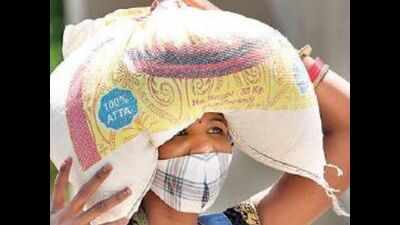
Not everyone returned happy from free grain distribution centres because arranging wheat and rice for such big crowds is not easy and the day’s provisions ran out before their turn came.
The lockdown has only worsened the situation by affecting their earnings. On Monday, TOI saw serpentine queues of those who did not have ration cards at Delhi government’s free grain distribution centres.
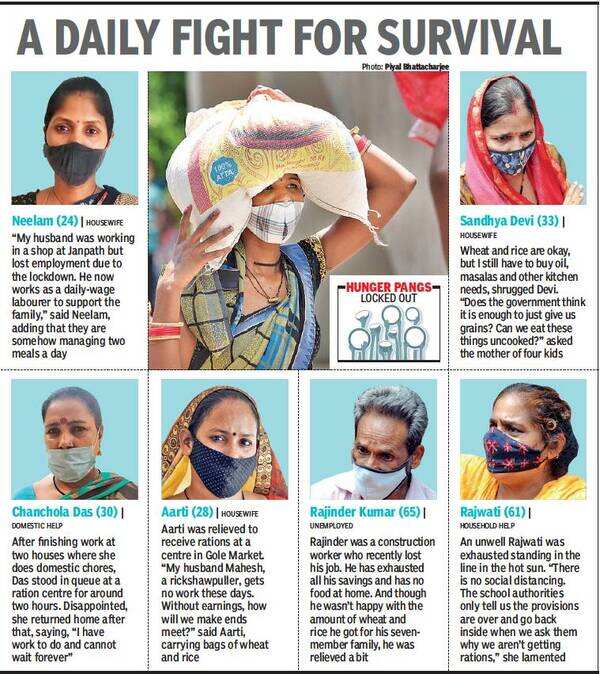
Not everyone returned happy from there because arranging wheat and rice for such big crowds is not easy and the day’s provisions ran out before their turn came.

Rajwati, 61, is diabetic, but hunger drove her to the Government Boys Senior Secondary School in Nand Nagri in northeast Delhi. She joined the queue at 3am on Monday, but she sadly failed to get a token for the rations being distributed there. “I have come here for three days now,” she said disconsolately.
When TOI went inside the school to check why, the distributors said there weren’t enough provisions for everyone and had to deny them tokens. “We have informed a few people that we have very little to give out, but the queue has only been increasing. What can we do?” said a teacher deployed there for distribution duties. “We had received 2,800 kg of wheat and 700 kg of rice, but those are finished. The people outside are threatening to vandalise the premises if we don’t give them rations. At the end of the day, we are just teachers and fear for our safety.”
Sheela Devi, 52, too was in the queue at the municipal corporation primary school in Dilshad Garden for three days. The domestic worker has a family of eight to support, her husband being bed-ridden and unable to work. “I have been waiting patiently, but they always ask me to come again the following day,” she grumbled. “Last year, we exhausted our savings during the lockdown and had to beg the local ration shop owners to give us some food, promising them we would pay later. They have been after our lives, but we haven’t been able to clear the dues.”
Seeing Devi’s disappointment at being turned away, a teacher explained, “The people don’t realise that we only have so much of provisions per day. They come and yell at us, but we can only give rations to those holding tokens.” Depending on the amount of wheat and rice, the distributors give tokens to those in the queues, the lucky ones being those at the top of the line.
Equally disappointed was Munni Devi, 35, at south Delhi’s Nehru Nagar. Munni and her 10-year-old son first reached the distribution centre on Saturday but returned empty handed after waiting from 11am to 4pm. Munni, a domestic worker, said, "The lockdown has severely affected my family of seven. It is frustrating to wait so long in the hot sun and not take home some foodstuff. I will try my luck on Tuesday.”
A mother of five children, Munni did household work for five families, but was asked by three not to come when the lockdown started. Her husband, Chavi Ram, a rickshaw puller, has hardly earned anything in the last month. “He goes out daily, but there are no passengers,” she said. “We were earning around Rs 10,000 a month before the lockdown, but are down to Rs 2,000 now. If we can’t make ends meet, we will have to return to our village in Etah in Uttar Pradesh.”
Amid similar discontent at Government Co-ed Senior Secondary School in Nehru Nagar, a teacher claimed, “When we opened a sack of rice, we found it unfit for distribution. We cannot give just wheat, so we asked the people to come on Tuesday when we will have more stocks.” Among those who were deprived of foodgrains because of this was Sonu Rawat, 30, a driving school instructor. Almost embarrassed to be seen in the queue, Rawat hesitantly revealed that his monthly income had reduced from Rs 14,000 to nil due to the lockdown, and he was at his wit’s end on how to feed his wife and two children.
One could feel sorry for Kamalnath, 80, a migrant from Bihar. He said he was too old to leave the city. As for those who could look after him, he had two granddaughters, but they were reluctant to find jobs. “I asked them to at least line up for the free rations, but they refused. They have lost their parents and I am responsible for their upbringing. I must find some way to give them meals,” the old man sighed.
End of Article
FOLLOW US ON SOCIAL MEDIA






Hot Picks
TOP TRENDING
Trending Stories
In City
Entire Website
- Malaika Arora's father Anil Arora dies by suicide in Mumbai
- 7 Key Reasons Why UPSC is the Toughest Exam in India
- 9/11 Remembrance Day: Key moments from the deadliest attack on US
- Howard University: 10 landmark firsts of the institution that shaped Kamala Harris
- Earthquake of magnitude 5.8 strikes Pakistan, tremors felt in Delhi, neighbouring areas
- Who were Barack Obama's challengers in 2008 and 2012 US presidential elections?
- 'A in INDIA alliance': Rahul Gandhi's slip-up during address to Indian-Americans goes viral
- Trump vs Harris: Betting markets reveal who’s expected to win the US presidential debate
- IGNOU December 2024 Term-End Exam: Registration Details, Important Dates, and Fee Structure
- Top 10 TED Talks to Boost Confidence and Success for Female Students
- Harris emerges unscathed from debate, dancing around her flip-flops
- After Kolkata docs set new demands, Mamata govt says 'not ready to accept'
- Why is creamy layer argument in SC/ST quotas so controversial?
- 'They would be in jail if ...': Kharge's attack draws BJP's 'Emergency' retort
- The Multan Mystery: When Dravid left Tendulkar stranded at 194*
- Ayushman Bharat scheme to be expanded to cover elderly above 70
- Is this India’s chance to replace Bangladesh as world’s clothing factory?
- Apple iPhone 16 vs iPhone 15: Which iPhone to buy and why
- Watch: PM Modi participates in Ganpati Puja at CJI's house
- MAGA's wild debate theories: Kamala's 'earphones' to 'witchcraft'

Popular Categories
Hot on the Web
Top Trends
Trending Topics
Deepika PadukoneMalaika Arora Father DeathArbaaz KhanJayram RaviAishwarya Rai BachchanSlat WaterWeight GainGOAT CollectionVikas Sethi DeathMalayalam ProducersIndia's Best Dancer 4Simi GarewalDilli BabuIndian National ParksLaung BenefitsVikas SethiiPhone 16Dubai Princess Sheikha MahraMG Windsor EvWordle Answer
Living and entertainment
Latest News
Manju Warrier expresses gratitude for birthday wishes: "Forever humbled and grateful"Jiiva and wife escape with minor injuries after a road accidentThe Zodiac Signs Most Naturally Inclined to HealingWhy Banyan trees survive for centuries and spread indefinitely?Telangana government pushes for increased flood relief from CentreShilpa Shetty and Raj Kundra spotted at the Siddhivinayak Temple; video insideNBA 2K25 locker codes September 2024: Locker codes revealed and know how to reveal themDonald Trump and Kamala Harris shake hands as they meet for first time on debate stage: Watch the 'awkward' momentBRS pushes for disqualification of turncoat MLAs after High Court rulingKamala may have won debate. But election is still too close to callPrince William’s commitment to a lasting marriage with KateVarun Dhawan shares unfiltered reaction to Janhvi Kapoor's 'Daavudi' song from 'Devara: Part 1': 'So freaking good...''On basis of fairness and equality': Bangladesh seeks good relations with India, says YunusJr NTR starrer 'Devara: Part 1' completes censorship formalities; receives UA certificateJalen Ramsey demands action against Miami Police following Tyreek Hill's pulled from car49ers RB Christian McCaffrey misses win over JetsWWE Superstar Blames the Company for Failing to Utilize Omos’ PotentialArbaaz Khan spotted outside Malaika Arora's house along with police after the tragic news of her father's demise by alleged suicide - WATCH VIDEO
Copyright © 2024 Bennett, Coleman & Co. Ltd. All rights reserved. For reprint rights: Times Syndication Service